CN
CNPhone:
19951065399

WHAT ARE YOU LOOKING FOR?
Ventilation is one of the most important systems in an aircraft spray booth because it directly affects overspray control, coating quality, worker conditions, and the removal of paint vapors from the spraying area. For aircraft painting, however, ventilation is not simply a matter of installing larger fans.
The supply air must reach the working zone without creating excessive turbulence, move consistently around a large and complex aircraft surface, and carry overspray toward the filtration and exhaust system. At the same time, the amount of incoming and exhausted air must be controlled so that booth pressure remains suitable for the coating process and surrounding facility.
This makes airflow, pressure, filtration, and exhaust design parts of the same engineering problem. Changing one can affect the others, especially in a large aircraft spray booth where the aircraft itself significantly changes how air moves through the enclosure.
Aircraft spray booth airflow is designed to move clean air through the painting zone while carrying overspray and vapors away from the aircraft and operators in a controlled direction.
Aircraft surfaces create a more difficult airflow environment than many smaller industrial parts. Wings, the fuselage, tail sections, access platforms, and maintenance equipment can interrupt the air path and create sheltered areas. If the airflow is poorly distributed, overspray may remain suspended near the work area or move across freshly coated surfaces.
Simply increasing fan capacity does not necessarily solve the problem. Excessive or uneven air movement can disturb the spray pattern and increase paint loss, while insufficient movement may reduce contaminant removal. What matters is achieving stable airflow where spraying actually takes place.
For reference, JZJ's current customized aircraft spray booth specification lists an airflow speed of at least 0.25 m/s. This should be understood as one project configuration rather than a universal value for every aircraft facility. Required airflow depends on booth geometry, coating material, application method, aircraft size, applicable regulations, and the ventilation calculation for the project.
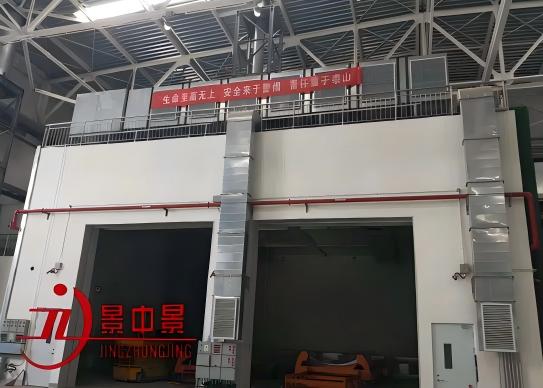
The appropriate airflow pattern depends on how the aircraft occupies the booth and how overspray needs to travel from the clean-air supply toward the exhaust system.
Large aircraft booths commonly use airflow arrangements that introduce filtered air from the upper part of the enclosure and remove contaminated air at a lower level. This encourages overspray to move away from the coating area rather than circulating through the booth.
Other layouts may use horizontal or modified airflow arrangements where building structure, floor construction, aircraft geometry, or retrofit conditions make a full downdraft design impractical. The decision should therefore consider much more than the name of the airflow pattern.
| Airflow Approach | Air Movement | Main Advantage | Design Consideration |
|---|---|---|---|
| Downdraft | Upper supply to lower exhaust | Moves overspray away from upper aircraft surfaces | Requires suitable lower exhaust or floor arrangement |
| Horizontal / Crossdraft | One side or end toward the opposite exhaust | Can simplify some facility layouts | Aircraft geometry can obstruct the airflow path |
| Modified / Semi-Downdraft | Upper supply with strategically positioned exhaust | Offers flexibility for retrofit projects | Distribution must be checked around wings and fuselage |
Regardless of configuration, the useful question is not simply "Which airflow type is best?" It is whether the air reaches the spray zone evenly and then leaves the booth without creating significant stagnant areas or uncontrolled recirculation around the aircraft.
Booth pressure is created by the relationship between supplied and exhausted air, so the two airflows should be designed as a coordinated system rather than as separate fan selections.
If substantially more air is exhausted than supplied, the booth tends toward negative pressure. This can help contain paint mist and vapors, but excessive negative pressure may pull dust or uncontrolled air through openings. If the supply side dominates, positive pressure can help resist outside contamination, but an improperly controlled condition may allow vapors or overspray to migrate toward adjacent spaces.
For aircraft finishing, the practical objective is controlled pressure rather than pursuing the greatest possible positive or negative differential. The correct strategy depends on coating quality requirements, safety considerations, facility zoning, door operation, and local standards.
JZJ's published aircraft booth example illustrates the basic balancing principle. Four intake fans are rated at 12,500 m³/h each, while two exhaust fans are rated at 25,000 m³/h each, giving the system equal nominal supply and exhaust capacities of approximately 50,000 m³/h before real operating losses and control adjustments are considered.
Filter loading also changes this balance over time. As intake or exhaust filters accumulate contaminants, pressure resistance increases. A booth that performed correctly with clean filters may therefore behave differently if filter condition is ignored.
An aircraft spray booth filtration system protects the coating area on the intake side and captures overspray before contaminated air reaches downstream exhaust components.
Incoming air should be filtered to reduce dust and other particles that could settle on a high-value aircraft finish. The supply plenum and filter arrangement also help distribute air over a broad area instead of allowing concentrated streams to enter the booth.
On the exhaust side, overspray capture protects ductwork and downstream equipment from excessive paint accumulation. The filter system must therefore be selected for the coating material and expected paint loading rather than treated as a generic accessory.
Pressure monitoring across filters can also provide useful operating information. Rising resistance indicates that airflow may be changing even when the fans themselves are functioning normally. This is one reason ventilation performance should be evaluated as a complete system instead of by fan power alone.
The exhaust system must remove contaminated air from the spray zone and discharge or treat it safely without allowing the exhaust stream to contaminate the booth's clean-air intake.
OSHA requires mechanical ventilation during spray operations and for sufficient time afterward to remove hazardous vapor concentrations. Its spray-finishing requirements also state that clean make-up air should be supplied in quantities equal to the air being exhausted. For solvent-based operations, exhaust volume must be sufficient to maintain vapor concentrations within the applicable safety limits.
In a large aircraft spray booth, this can represent a substantial amount of conditioned air. Exhaust design therefore affects much more than worker protection. It also influences heating or cooling demand, filtration costs, duct dimensions, fan energy consumption, and the environmental-control strategy for the facility.
VOC treatment may also be necessary depending on the coatings, paint consumption, production level, and local emissions regulations. Technologies should be selected from actual exhaust concentration and flow conditions rather than added as a standard component without process data.
A larger aircraft spray booth generally requires more careful airflow distribution because increasing enclosure size changes the amount of air that must be moved and the distance it must travel through the working zone.
This is particularly important when moving from helicopter or business-jet applications to booths intended for regional or larger commercial aircraft. Increasing width, height, or length without reconsidering air distribution can produce areas where the required airflow is difficult to maintain.
The aircraft itself must also be considered during ventilation design. A large fuselage can divide the airflow, while wings and access platforms can redirect it. Engineers therefore need the aircraft dimensions, booth layout, coating process, application rate, working positions, and expected operating conditions before selecting the final supply and exhaust configuration.
JZJ designs customized aircraft painting systems rather than relying on one fixed ventilation configuration for every project. Buyers planning a new aviation coating facility can contact JZJ with aircraft drawings, facility dimensions, coating information, and production requirements so that booth size and ventilation can be considered together.
Effective aircraft spray booth ventilation is the result of balance. Clean supply air needs to reach the coating area evenly, booth pressure must remain controlled, filters need to support both finish quality and overspray capture, and the exhaust system must reliably remove contaminated air from the working environment.
For this reason, an aircraft spray booth should not be specified by fan capacity alone. Aircraft geometry, booth dimensions, coating materials, operator positions, filtration resistance, environmental requirements, and exhaust treatment all influence the final design.
Evaluating these factors together creates a more stable painting environment and helps avoid problems that can appear later as uneven airflow, excessive filter loading, contamination, high energy demand, or insufficient exhaust performance.
Ventilation supplies clean air to the painting zone while removing overspray, paint mist, and vapors toward the exhaust system. It also helps maintain stable conditions around the aircraft during coating.
There is no single pressure strategy for every booth. The pressure relationship should be engineered according to contamination control, vapor containment, facility conditions, coating process, and applicable safety requirements.
Usually the ventilation requirement increases with the scale of the working area, but fan size should be based on airflow calculations, booth geometry, pressure losses, filters, ducts, and process requirements rather than booth volume alone.
As filters collect dust and overspray, their resistance increases. This can reduce airflow or change booth pressure unless the system is monitored and adjusted or the filters are replaced when required.
The supplier should know the aircraft dimensions, booth size, coating materials, spraying method, production requirements, facility conditions, required temperature and humidity range, exhaust-treatment needs, and applicable local standards.