CN
CN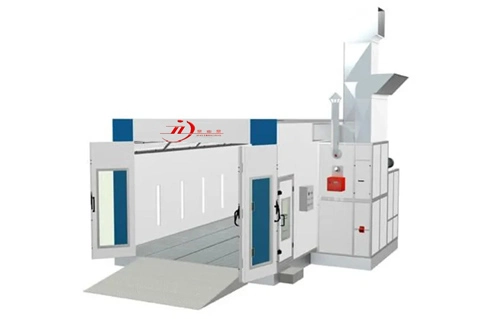
Phone:
19951065399
WHAT ARE YOU LOOKING FOR?
In 2026, the coating industry faces a technological revolution driven by automation. Integrating robotic arms into a large equipment paint booth transforms surface finishing processes, delivering millimeter-accurate coating thickness, reducing paint waste by up to 30%, improving worker safety, and doubling production capacity. For sectors like aerospace, wind energy, and heavy machinery, automated systems are essential for staying competitive in a high-demand global marketplace.
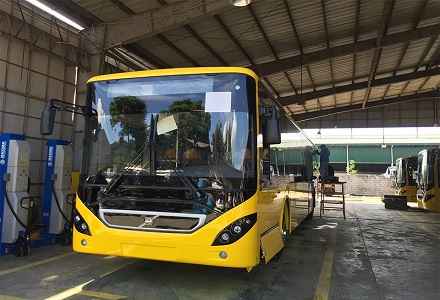
Advanced manufacturing industries struggle with labor shortages and heightened expectations for precision. Coating massive parts, such as electric bus panels or turbine blades, demands consistent thickness and superior surface quality—tasks that manual methods cannot reliably achieve. Automation ensures performance consistency. For example, human-operated spray guns often cause "gravity sag" on 15-meter parts, while robotic systems eliminate uneven film build entirely.
Robotic arms equipped with intelligent spray heads guarantee repeatability across complex geometries, enabling production efficiency and compliance with tightening tolerances. With automation, manufacturers gain the ability to meet stringent requirements while reducing human exposure to hazardous high-VOC environments.
Matching robotic systems to large equipment paint booths requires certified safety standards. Both the robotic arm and booth must meet ATEX or Class I, Div 1 explosion-proof certifications to operate safely when spraying flammable coatings, such as solvent-based paints.
Creating a synchronized environment is critical when integrating automation. Programmable Logic Controllers (PLCs) enable communication between booth sensors and robotic systems. For instance, air pressure sensors within the booth monitor airflow dynamics, ensuring laminar flow to prevent paint particle turbulence during application.
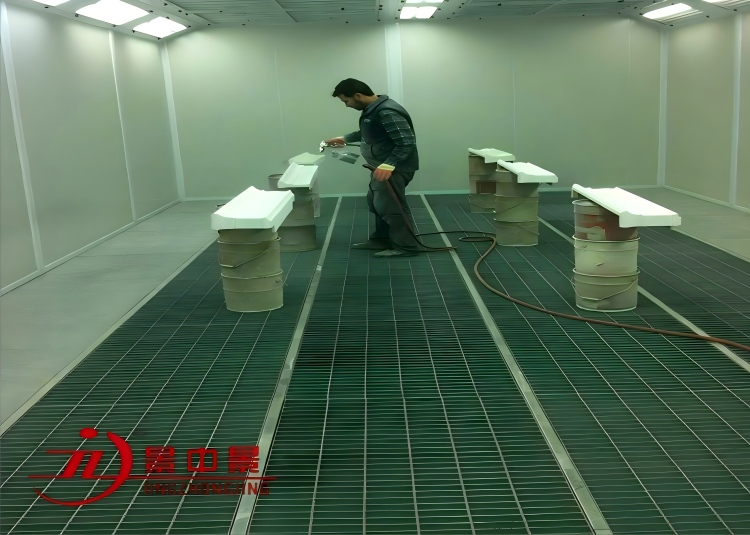
When designing a large equipment paint booth, the airflow dynamics must align with the spray velocity of the automated arm to achieve perfect coating results.
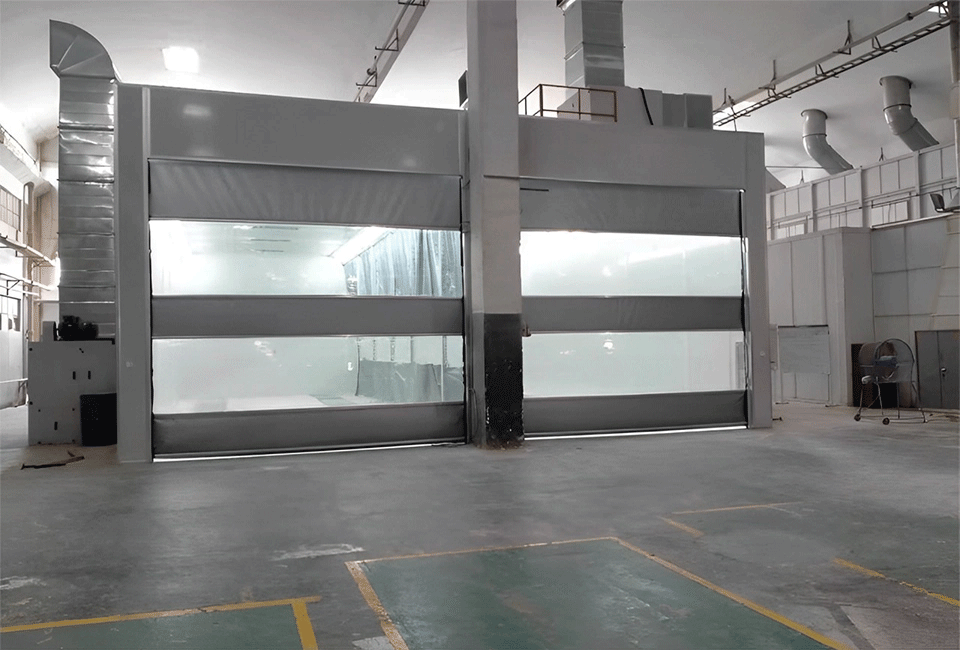
Ensuring optimal booth design for robotic operations involves selecting the right airflow profile. Between side-draft and down-draft systems, downdraft configurations typically perform better by directing paint overspray directly toward the filtration grid, preventing cross-contamination between multiple robotic arms working simultaneously.
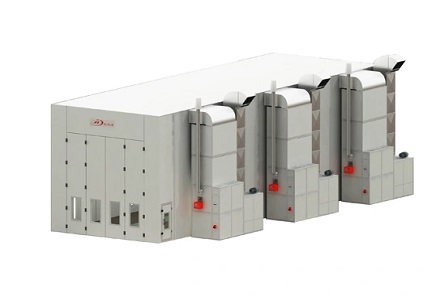
JSJZJ booths can integrate ceiling-mounted or floor-based rail systems, enabling robotic arms to move along large parts, like 20-meter wind turbine blades. These tracks offer unprecedented flexibility, allowing a combination of articulated robotic arms tailored for multi-directional application.
A smart large equipment paint booth behaves like a science laboratory, delivering climate control integral to robotic applications. Constant humidity and temperature ensure high-solid paints dry evenly, crucial for maintaining the formulation integrity required by wind and aerospace components.
Investing in robotic paint shop technology isn’t just about efficiency—it’s an opportunity for measurable cost savings and quality improvements. Here’s what the data shows:
Coating Consistency: Up to a 95% reduction in rework due to uneven coats.
Material Savings: Electrostatic robotic spray heads cut paint consumption by 25-40% compared to manual methods.
Energy Optimization: Intelligent HVAC systems only ventilate active zones where robots are working, reducing energy consumption dramatically.
JSJZJ booths are equipped with cutting-edge VOC capture systems, featuring multi-stage carbon filtration to handle the high spray volumes generated by robotic systems operating at rapid speeds. This ensures compliance with stringent environmental laws.
As automation eliminates human exposure to hazardous environments, sprayers transition into system supervisors who oversee operations from control rooms. This shift improves factory safety while boosting overall employee satisfaction.
Yes, JSJZJ offers retrofitting services for existing booths, enabling facilities to upgrade to robotic systems without replacing the full booth. This includes:
Floor Reinforcement: Reinforcing booth flooring to support robotic tracks.
Sensor Integration: Installing high-precision sensors for airflow monitoring.
Electrical Cabinet Upgrades: Ensuring optimal power supply compatibility for robotic systems.
Automation is reshaping how industrial facilities approach paint operations for large equipment. By integrating robotic arms into customized JSJZJ booths, manufacturers can achieve precision, efficiency, and safety—maximizing ROI and scaling production for the future.